PCMIS

MVP v1.0 Released

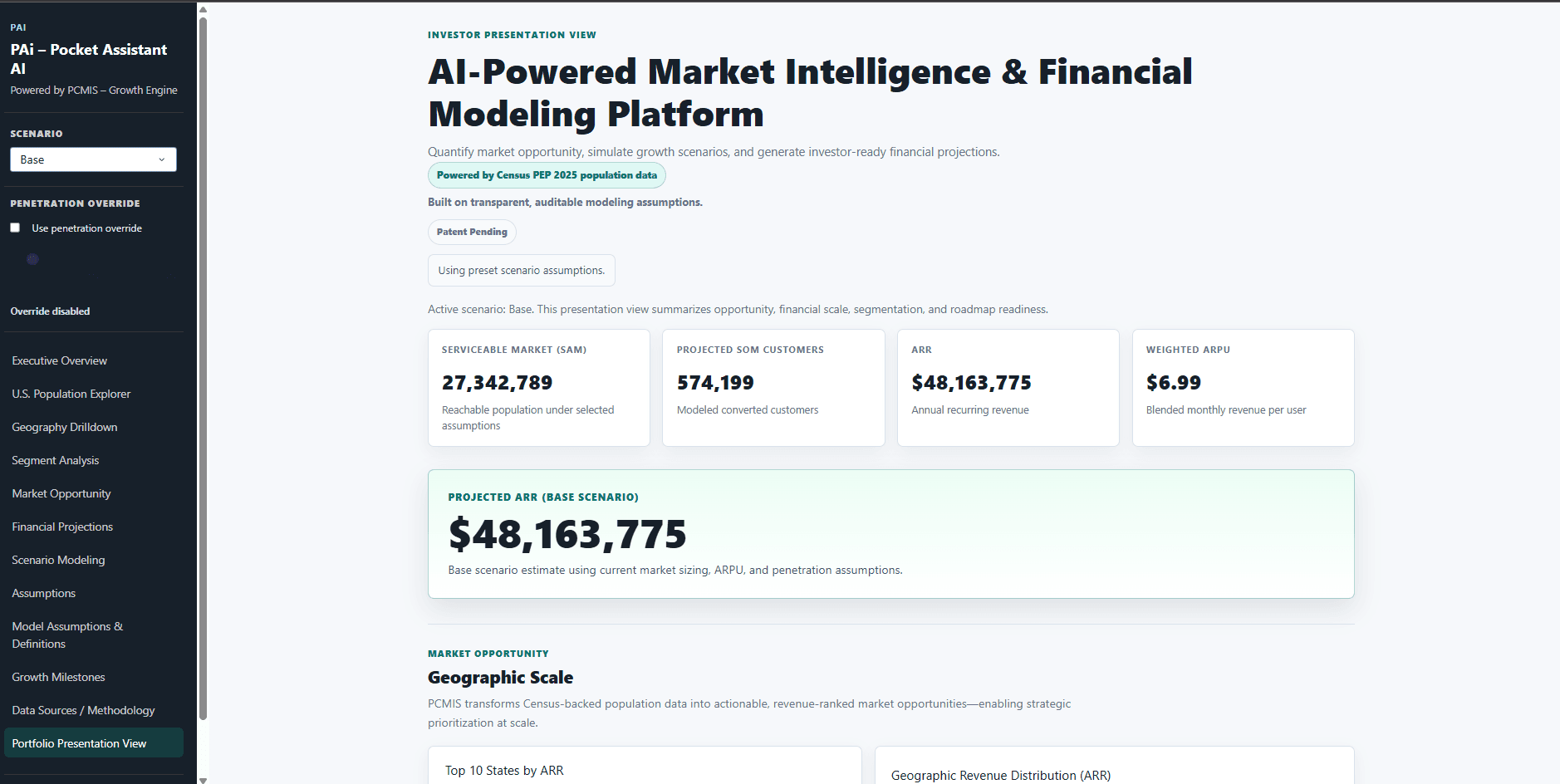
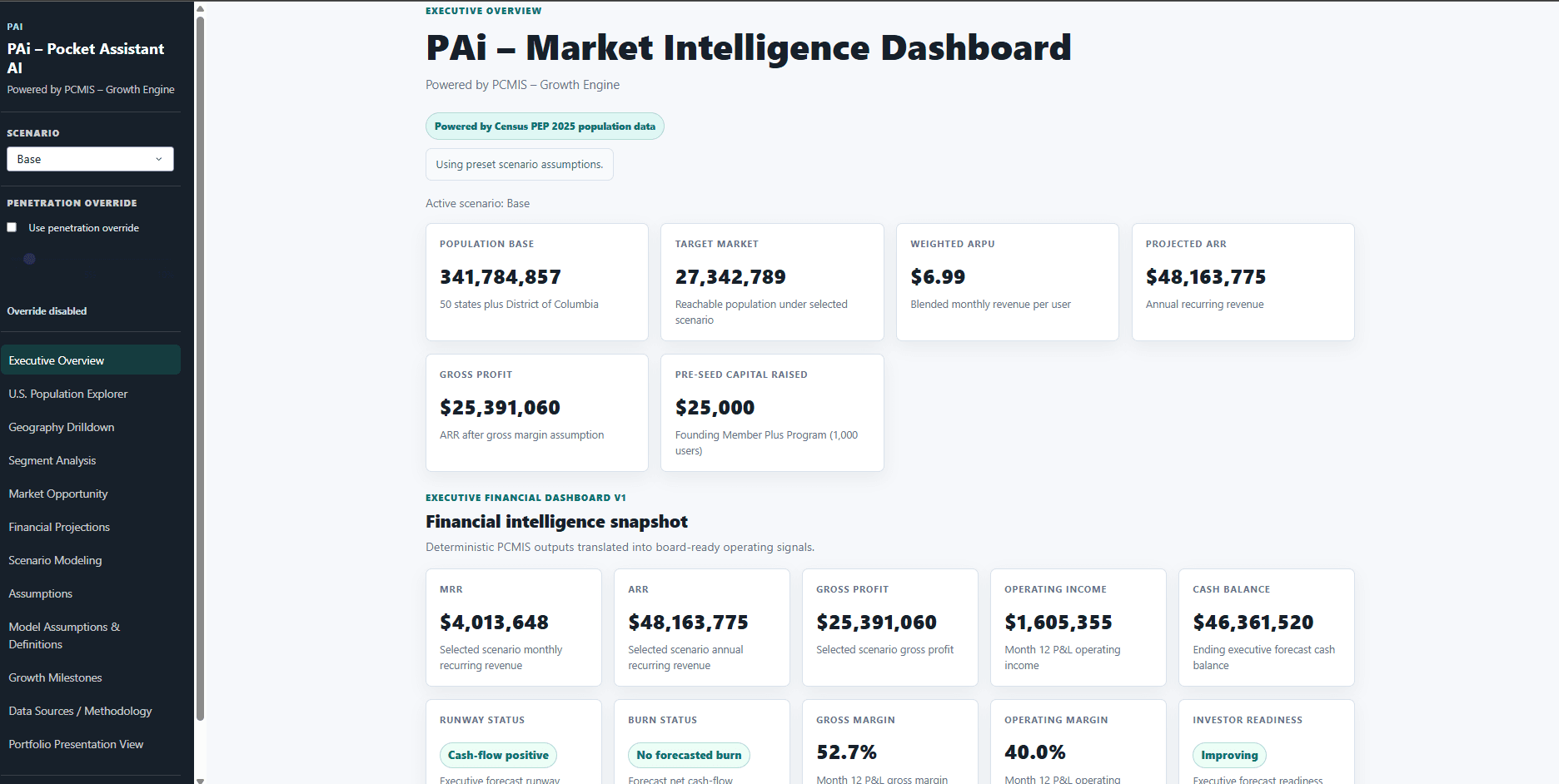
Population & Customer Market Intelligence System — a market-intelligence, scenario-modeling, financial-planning, and executive decision-support system that connects population data and configurable assumptions to strategic planning outputs.

My responsibilities

PCMIS connects market research, population intelligence, scenario modeling, financial planning, and software implementation into an explainable executive decision-support system.

From population data to business decisions.

PCMIS transforms population data, market assumptions, segmentation, subscription economics, and financial inputs into a connected planning system for market sizing, geographic prioritization, scenario analysis, financial modeling, and executive decision support. It is designed to make the assumptions behind a planning view visible so leaders can explore alternatives rather than depend on a single opaque forecast.

Business context

Early-stage product and commercialization planning can require a defensible connection between addressable population, target segments, market opportunity, subscription assumptions, operating economics, and financial outcomes. PCMIS was built to turn those interdependent questions into a connected, reviewable planning workflow.
Strategic objective

Create an auditable market-intelligence and financial-planning system that moves from public population data and explicit assumptions to geographic priorities, scenario comparisons, modeled financial trajectories, risk signals, and executive-ready planning outputs.

  1. 01Population Data
  2. 02Market Assumptions
  3. 03Segmentation
  4. 04TAM / SAM / SOM
  5. 05Geographic Prioritization
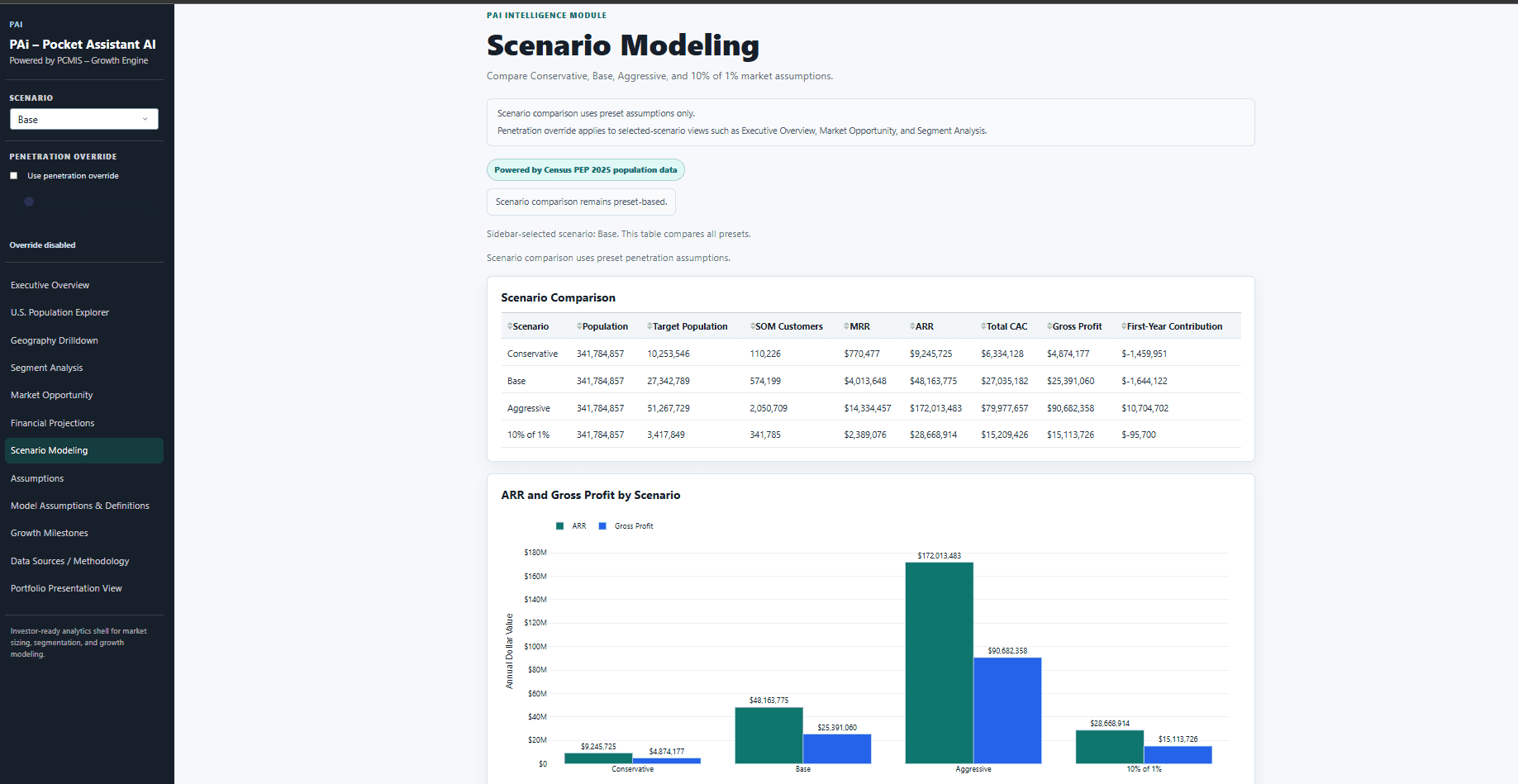
  6. 06Scenario Modeling
  7. 07Subscription Economics
  8. 08Financial Planning
  9. 09Forecast & Risk Analysis
  10. 010Executive Decision Support
  11. 011Executive Reporting

Each stage exposes inputs and modeled outputs so population intelligence, market opportunity, operating assumptions, and financial planning can be considered as one connected decision chain.

Five connected responsibilities behind the growth engine.

01

Business Leadership

Connected product opportunity, market research, commercialization questions, strategic planning, and executive decision-support requirements into a coherent business case for a planning system rather than an isolated dashboard.

02

Financial Planning

Designed market-sizing, subscription-economics, scenario, contribution, P&L, cash-flow, runway, break-even, and SaaS KPI models to make planning assumptions and their financial implications reviewable.

03

Product Leadership

Defined analytical workflows, scenario controls, dashboard requirements, planning outputs, executive reporting, and the decision-support experience that connects detailed models to leadership questions.

04

Technical Leadership

Architected the Python and Dash analytical application, validated population-data pipeline, modeling layers, visualization approach, deterministic recommendation logic, and Excel reporting design.

05

Engineering Execution

Led hands-on, AI-assisted engineering and review across the population-data pipeline, analytical modules, dashboards, validation, financial calculations, deterministic forecasting, rules-based insights, and executive Excel export.

Connected models from market opportunity to executive planning.

Population & Market Intelligence

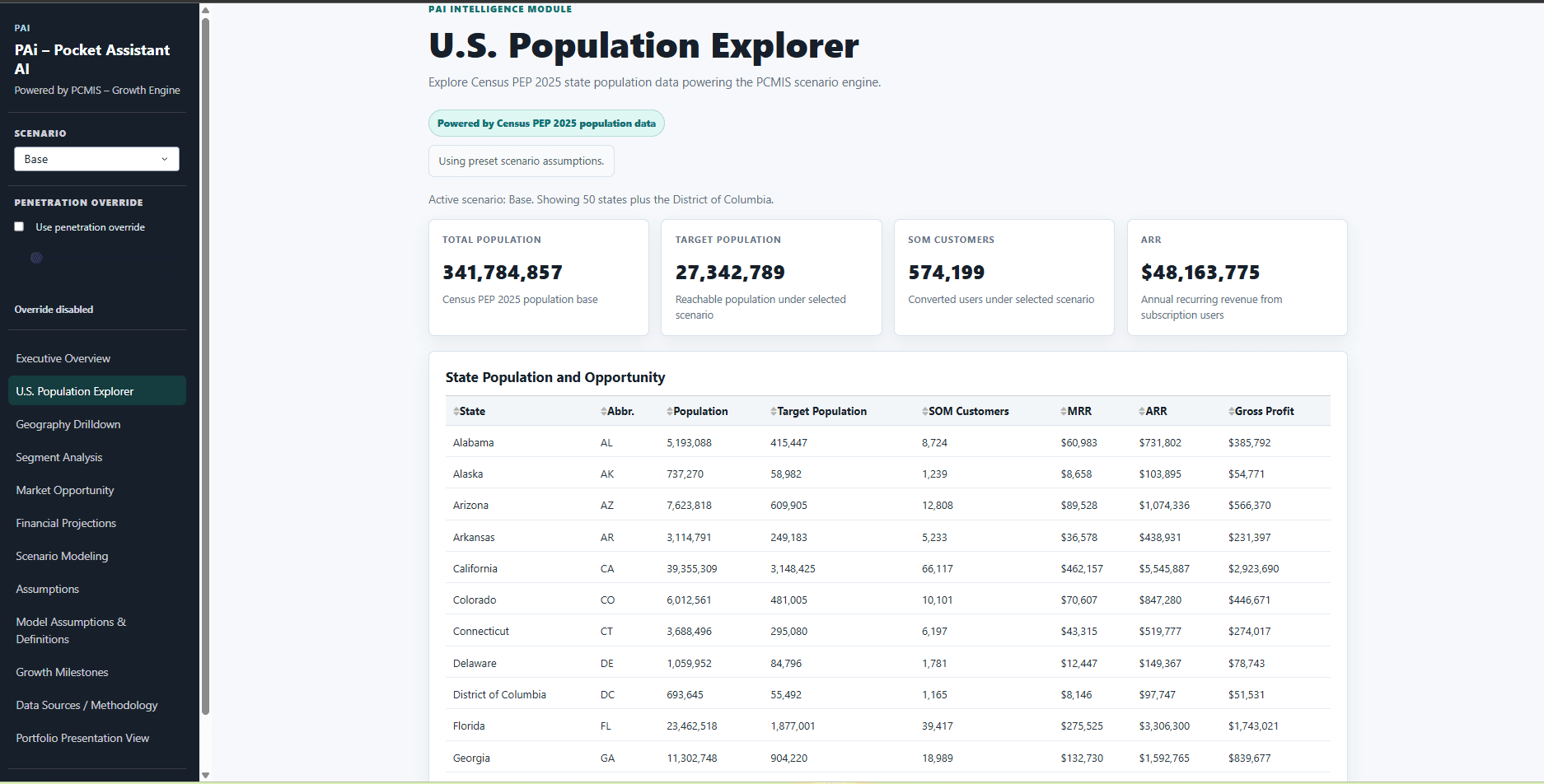
Validated Census PEP 2025 state-population data supports analysis across all 50 U.S. states and Washington, D.C., connecting public population context to addressable-market questions.

TAM / SAM / SOM & Segmentation

Configurable market assumptions and segmentation translate broad population context into total, serviceable, and obtainable market views rather than leaving the planning basis implicit.

Scenario & Penetration Modeling

Conservative, base, aggressive, and additional penetration assumptions make the sensitivity of strategic plans visible before a single forecast becomes a decision anchor.

Geographic Opportunity Intelligence

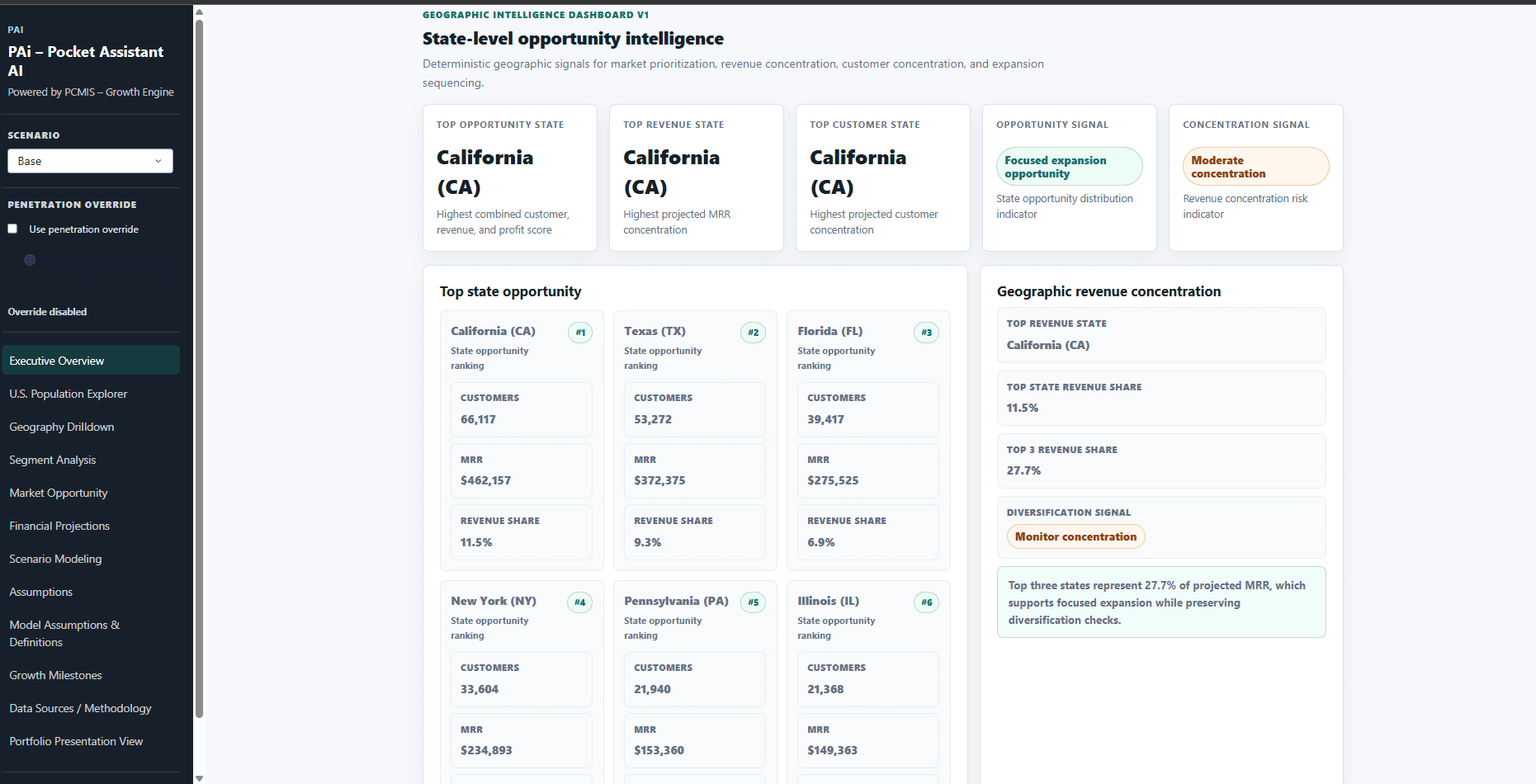
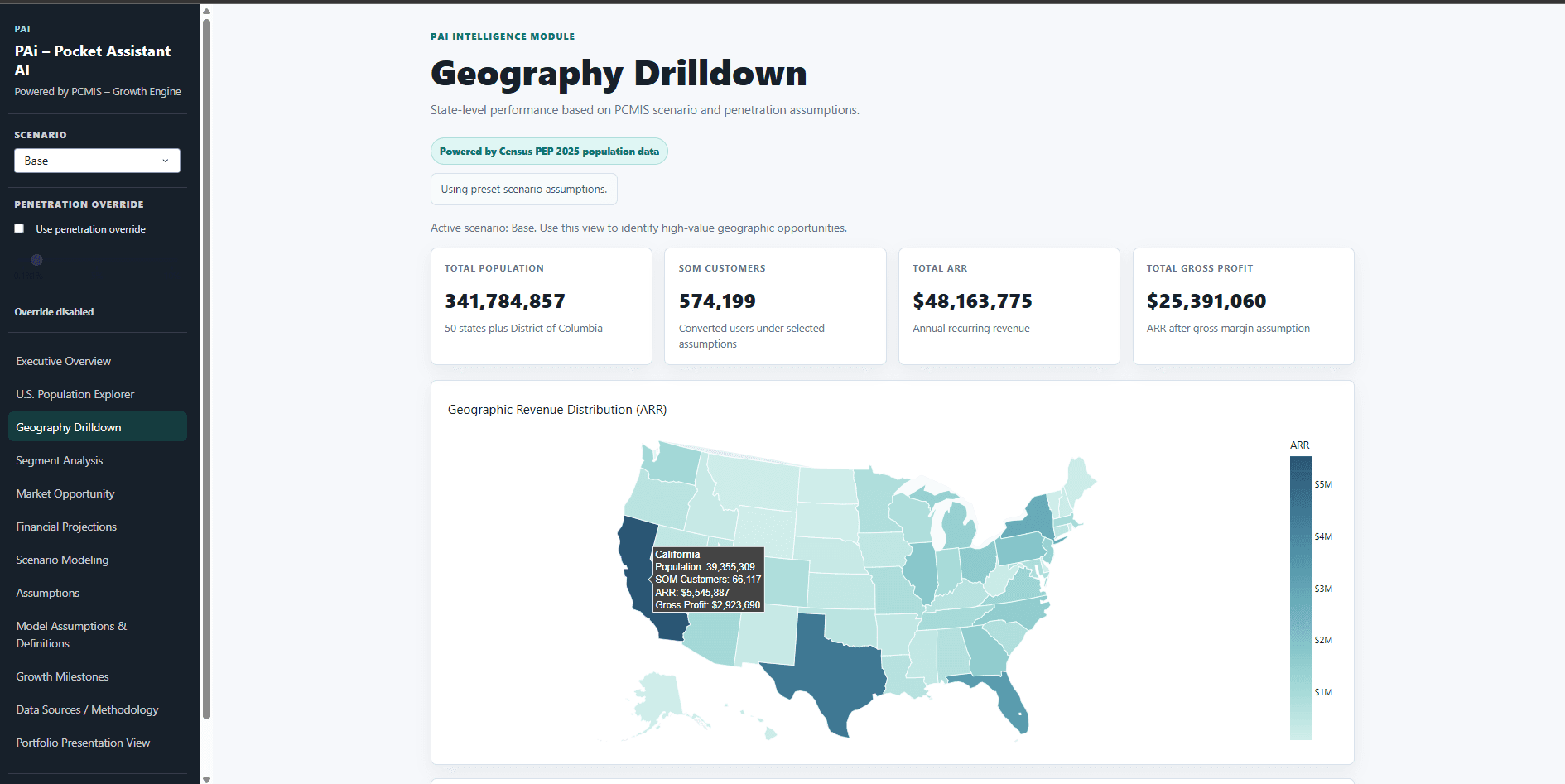
State-level opportunity modeling and geographic views help compare concentration, prioritization, and modeled market potential across locations.

Subscription Economics & FP&A

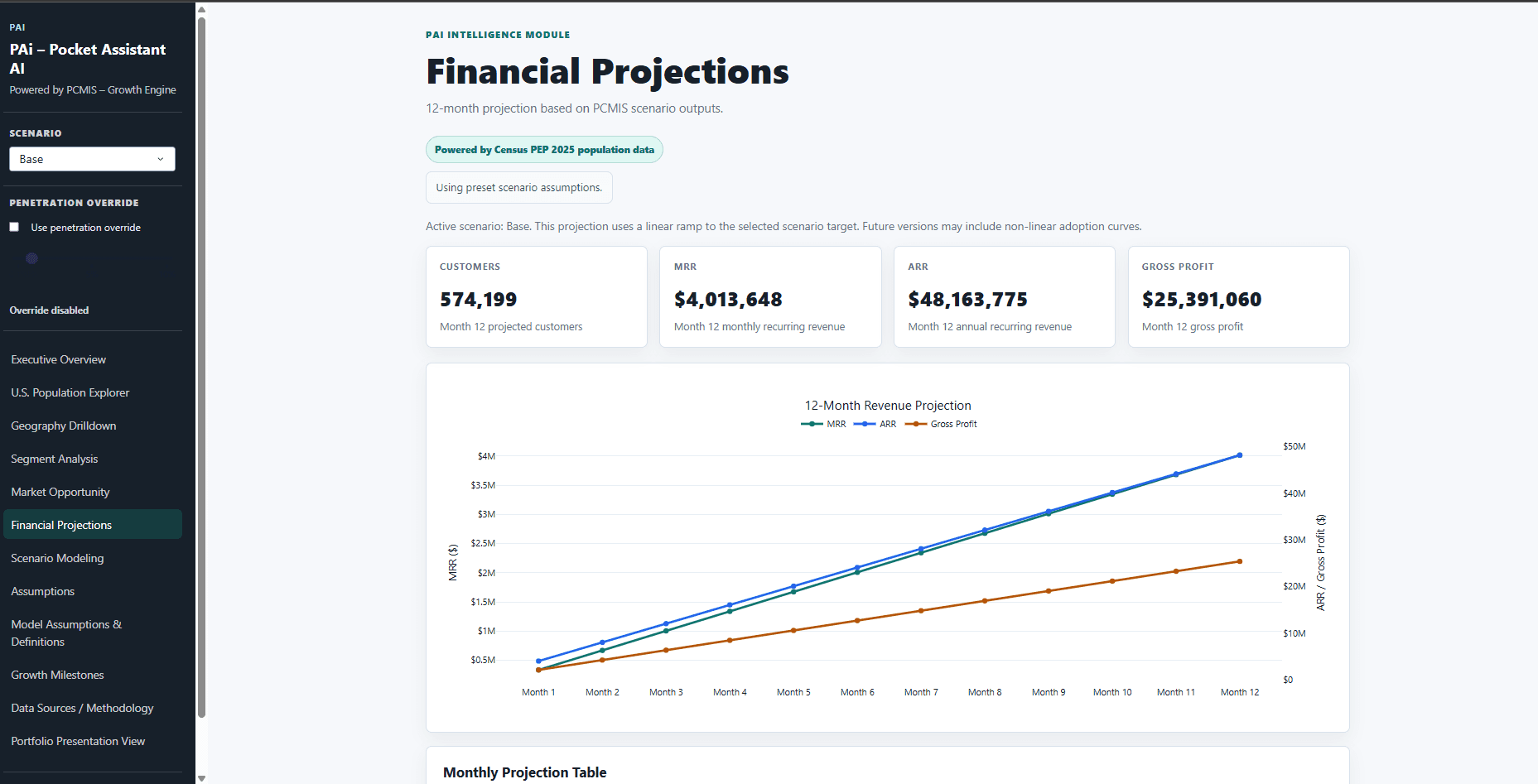
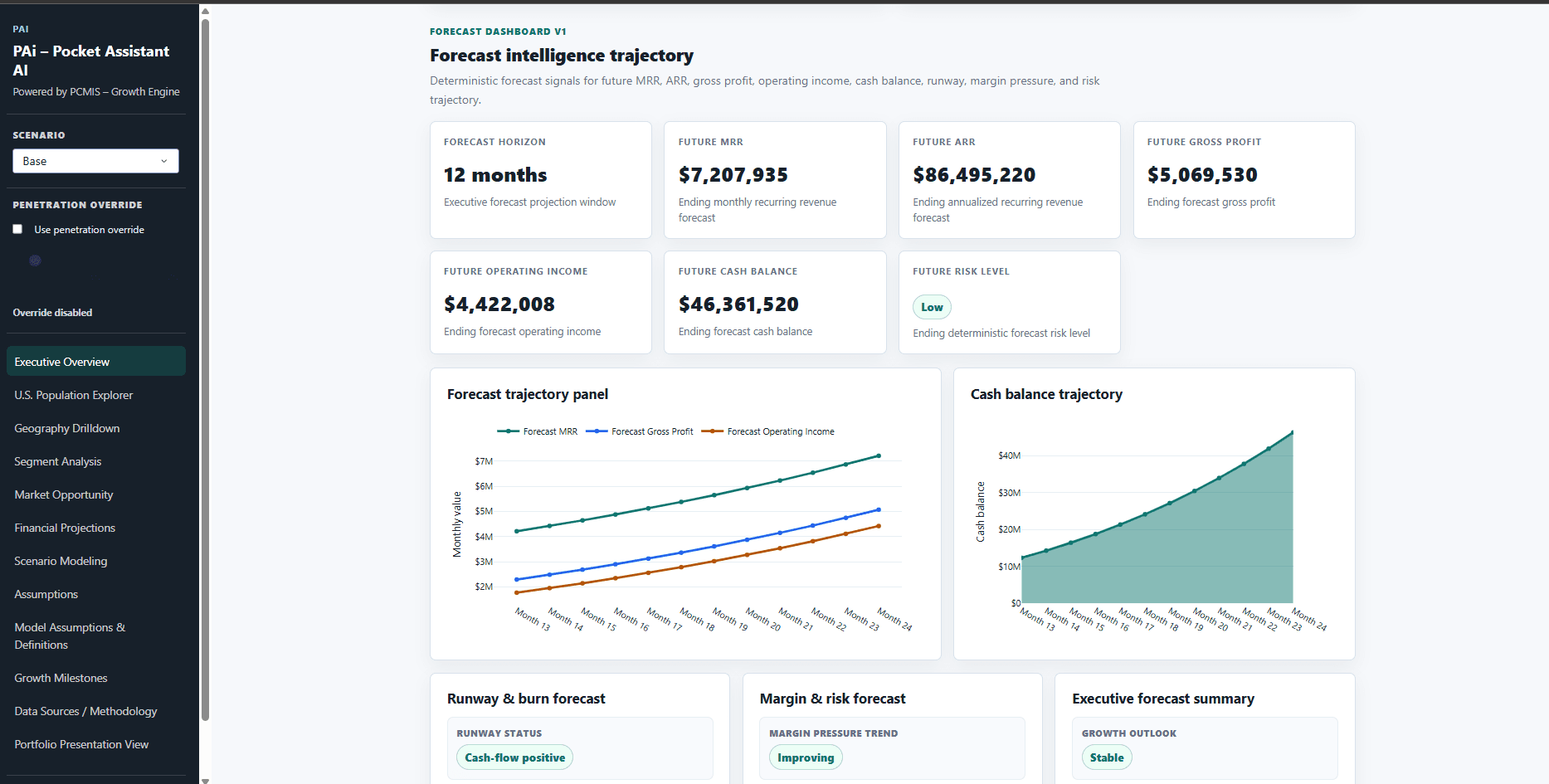
Subscription assumptions connect to modeled MRR, ARR, CAC, gross profit, contribution, monthly P&L, cash flow, runway, break-even, and SaaS KPI analysis.

Deterministic Forecast, Risk & Guidance

Explainable, assumption-driven forecasting, risk signals, recommendation logic, strategic guidance, and CFO-style analytical narratives turn model state into reviewable executive context.

Financial truth remains in the model.

PCMIS currently uses deterministic, rules-based, and assumption-driven calculations for forecasting, risk analysis, recommendation logic, strategic guidance, and CFO-style insight narratives. These outputs are explainable because they remain connected to the configured model inputs and calculation layers.

The current implementation does not present generative AI, LLMs, OpenAI integration, machine learning, or predictive AI as completed capabilities.

Dynamic planning workbooks built from current model outputs.

PCMIS generates formatted executive planning workbooks for one-, two-, and three-year horizons. The workbook structure brings together executive summary, strategic snapshot, deterministic recommendations, risk, assumptions, revenue, subscriber growth, operating expenses, monthly P&L, cash flow and runway, break-even, SaaS KPIs, geographic and demographic intelligence, and methodology views.

The export supports further planning and review; its historical “AI Recommendations” sheet name refers to the current deterministic rules-based recommendation layer, not an LLM implementation.

A modular analytical system built for reviewable planning.

PythonDashDash Bootstrap ComponentsPlotlypandasNumPyOpenPyXLCSV Data PipelineCensus PEP 2025 Population DataDeterministic Financial ModelingRules-Based Recommendation LogicExecutive Excel Reporting

PCMIS separates validated population data, configurable market and financial assumptions, deterministic analytical modules, dashboard visualizations, rules-based insight layers, and workbook generation so decision support can evolve without obscuring the underlying calculation model.

MVP v1.0 Released

The current PCMIS MVP implements deterministic, assumption-driven market intelligence, scenario modeling, financial planning, forecasting, risk analysis, rules-based recommendations, CFO-style insight narratives, executive dashboards, and dynamic Excel planning exports. Financial and customer figures shown in this profile are modeled outputs and projections, not realized commercial outcomes.

Current intelligence is deterministic, rules-based, and explainable. It is not presented as LLM-powered, generative-AI, machine-learning, or predictive-AI functionality.

Inspect the PCMIS market-intelligence application.

Interpret the model without replacing it.

Future direction can add optional predictive and statistical intelligence, followed by an AI / LLM reasoning and explanation layer with governance and human review. The LLM should interpret the financial model; the LLM should not become the financial model. Deterministic and auditable calculations remain the authoritative source of financial truth.

Need a more connected view of market opportunity and financial planning?

PCMIS demonstrates how business strategy, market research, quantitative analysis, financial planning, product strategy, analytical architecture, and hands-on engineering can become one executive decision-support system.

Contact Antonio